Q1 What has your journey been like in the lubricants industry before and after starting MAG Lubricants, and what inspired you to start the company?
My journey in the lubricants and automotive space began more than 15 years ago, working closely with OEMs, fleet operators, and workshops across the region. Over time, it became clear that many fast-growing markets were stuck between very expensiveTier 1 brands and inconsistent, low-trust local offerings, with a real gap for high-quality, certified lubricants at a competitive price point.
MAG Lubricants was born to bridge that gap: a UAE-based manufacturer with global standards, blending reliability, affordability, and speed of execution. The inspiration was simple but powerful—to build a brand from the Gulf that could stand confidently on the same shelf as international names, while staying agile enough to tailor solutions for developing markets in the Middle East, Africa and Asia.
Q2 What is the history of MAG Lubricants and in which markets are you present, and what has been the reception to MAG Lubricants as a brand and its products?
MAG Lubricants was established in 2013 in Dubai, with a state-of-the-art, fully automated blending facility covering about 30,000 square meters in National Industries Park, Jebel Ali. The company grew rapidly, recording around 100% year-on-year growth in its early years and building a strong export footprint from the UAE into multiple continents.
MAG Lubricants has built a strong presence across the Middle East and Africa, with growing penetration into Asia and other emerging markets. Today, our products are exported to more than 65 countries, depending on segment, with a particularly strong base in MENA and Africa.
The reception in these markets has been very encouraging: customers recognize that they are getting UAE-manufactured, ISO 9001, ISO 14001, ISO 45001-compliant lubricants with modern additive technology, supported by responsive technical and commercial teams. In regions where mineral oils still dominate but quality expectations are rising, our positioning as a value-for-money, quality-focused brand has allowed us to win share from both local blenders and some global competitors. We have been doing exceedingly well to an extent of being market leaders in semi synthetic and fully synthetic range of lubricants across chosen markets.
Q3 MAG Lubricants is operating in a competitive global lubricants market. What do you believe gives your business a distinctive and competitive edge?
There are four main pillars of our competitive edge. First, our Jebel Ali blending plant is fully automated, designed with advanced French technology, and capable of up to about 100,000 metric tons per year—this gives us consistent quality, scalability, and cost efficiency in one hub strategically located between East and West.
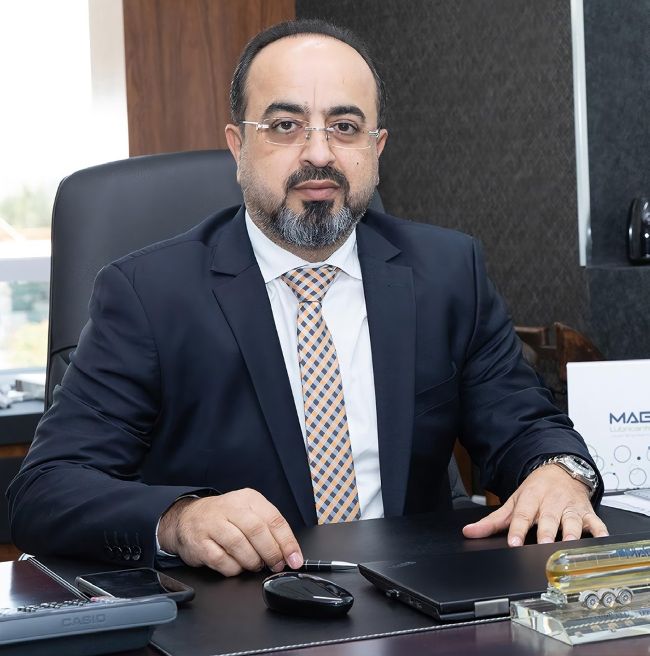
EXPERT INTERVIEW Mahmoud Al Theraawi, MAG Lubricants CEO.
Second, we are deeply customer-centric: we can customize formulations for specific climates, fuel qualities, and duty cycles, while still aligning with international standards and OEM requirements.Third, being part of a broader energy and logistics group enables integrated supply—from base oils to finished products—reducing lead times and volatility for our partners. And finally, our focus on fast-growing, under-served markets means we are not just another global player; we are a specialist in emerging-market realities, from Africa’s price-sensitive fleets to the Middle East’s performance-driven segments and adding America’s and creating an imprint in Asia.
Q4 How do you prioritize markets for expansion (for example, the Middle East vs Africa vs elsewhere)?
Market prioritization for us is a disciplined mix of data and on-the-ground insight. We look at three main metrics: lubricant consumption per capita and per vehicle, forecast CAGR, and the regulatory/ competitive environment in each country. Africa, for example, is forecast to grow from 3–5% CAGR, driven by vehicle parc growth and infrastructure spending, which makes it a natural priority. Within the Middle East, we already operate from a strong home base in the UAE and build outwards into neighboring GCC and extended MENA markets where the automotive and industrial sectors are expanding. In practice, that means: stabilize and deepen share in core Middle East, aggressively grow scale in high-growth African economies, and selectively enter American and Asian markets where our value proposition and logistics model give us an edge.
Q5 How do you balance scaling quickly (e.g., entering new geographies) with maintaining quality, brand integrity, and customer trust?
Scaling fast is only meaningful if customers trust the product in their engines, gearboxes, and equipment.Whenever we enter a new geography, we lead with technical credibility—product approvals where applicable, field trials with fleets, and training for distributors and workshops—before chasing volumes aggressively. At the same time, our integrated supply chain and centralized manufacturing allow us to roll out new markets without fragmenting our quality controls, so whether a drum is delivered here in Dubai or shipped to Accra or Nairobi; the blend integrity remains identical.
Q6 What are the biggest emerging trends in the lubricants and fluids industry (regionally or globally) that you are observing, and how does MAG Lubricants intend to realign itself?
Globally and regionally, several trends are reshaping lubricants. Engine oil demand is gradually shifting towards lower-viscosity, higher-performance grades with better fuel economy and emissions performance, while in many African and emerging markets mineral oils still hold over 80–90% share but semi-synthetics are growing. At the same time, electrification is driving demand for specialized fluids—such as e-drive coolants and thermal management fluids—while industrial customers expect longer drain intervals and reduced total cost of ownership.
MAG Lubricants is realigning by expanding its portfolio of synthetic and semi-synthetic automotive products, enhancing industrial offerings with extended-drain and energy-efficient formulations, and preparing a focused line of fluids suited for hybrid EV platforms in our key regions.
Q7 The Middle East is a major producer, while Africa represents a fast-growing consumer market. How does MAG Lubricants navigate this dynamic between supply and demand?
The Middle East is a powerhouse in base oils and energy logistics, while Africa is one of the fastest-growing demand centers for finished lubricants. Our strategy is to use the UAE as a stable, efficient manufacturing and export hub, then build distribution and partnerships deep inside African markets to be close to end-users.
By blending in Jebel Ali and shipping finished goods into Africa, we leverage competitive freight routes, port infrastructure, and storage to ensure reliable supply in markets that often suffer from inconsistent availability. This hub-and-spoke model allows us to balance supply and demand dynamically: we can ramp up production for high-growth African markets without overburdening local infrastructure, while keeping quality and specifications under tight centralized control.
Q8 What are some of the biggest challenges you’ve faced entering African markets: logistics, policy, or market education?
Africa is a high-potential, but high-complexity, opportunity. Logistics can be challenging due to port congestion, inland transportation constraints, and fragmented distribution networks. Policy and regulatory environments differ widely by country, with varying import duties, standards enforcement, and licensing requirements.
»By blending in UAE and shipping finished goods into Africa, MAG Lubricants leverages competitive freight routes, port infrastructure, and storage to ensure reliable supply in markets that often suffer from inconsistent availability of international standard Lubricants.
Market education is another key challenge: in many segments, end-users focus purely on upfront price, with limited awareness of the lifetime cost benefits of better-quality lubricants, longer drain intervals, and OEM-compliant products. We address this by partnering with strong local distributors, investing in technical training and joint marketing, and adopting flexible pack sizes and product lines that match local purchasing power while still raising the quality bar.
Q9 How do you see the competitive landscape evolving as more global and regional lubricant brands enter Africa?
As Africa’s lubricants market grows more, global and regional brands are entering or deepening their presence, including major international oil companies and regional champions. Over time, this will shift the market from purely price-driven to more segmented, with clear tiers for premium OEM-approved products, mid-tier value offerings, and purely budget lines.
MAG Lubricants is positioning itself squarely in the“reliable value”space: high and consistent quality, strong technical backup, and competitive pricing suited to fleet owners, workshops, and industrial users who want to step up from unbranded oils without paying top-tier multinational premiums. As competition intensifies, the winners will be brands that combine product integrity with local relationships, training, and after-sales support—and that is exactly where we are investing.
Q10 What are the future plans for MAG Lubricants in terms of the next frontiers for growth, and how do you plan to strengthen your regional presence?
Looking ahead, our growth story has three main frontiers. First, deepen penetration in existing Middle East and African markets by expanding our distributor network, product training, and OEM collaborations, aiming to significantly increase our share of automotive and industrial segments over the next few years.
Second, selectively enter new high-growth markets in East, West, and Southern Africa, as well as targeted American and Asian countries. Third, broaden our portfolio beyond traditional engine oils into specialty fluids, industrial greases, and emerging mobility fluids, aligning with global shifts in mobility and industry. The vision is clear: build MAG Lubricants into a trusted regional champion from the Gulf that is synonymous with dependable quality, smart value, and long-term partnership across the world’s fastest-growing lubricant markets. .