The ICIS recently held its 10th African Base Oils and Lubricants Conference in Cape Town, South Africa, on 13th and 14th of November 2025. The conference brought together different players in the lubricants industry from the African continent, as well as the Middle East, Asia, North America, and Europe.
Amanda Hay, the Senior Editor Manager at ICIS, while opening the conference, highlighted some of the goals were to drive positive market change, share more data on Africa’s lubricant market, and offer market intelligence on opportunities and challenges.
The conference provided an opportunity for networking and in-depth discussions on topics relevant to Africa’s lubricants industry covering market growth outlook, base oil demand, the outlook for the uptake of Group II base oils, the supply chain, electric vehicles, formulating for the African continent, counterfeits, and the regulatory landscape for Africa.
By 2060, Africa’s population is expected to reach 1.1 billion, and its economy is expected to grow at a 4% CAGR. Rising population, an expanding middle class with higher spending power, and industrialization drive this growth.
Africa’s lubricant market is expected to grow at a 4% CAGR over the next 5 years. Nigeria is the largest market due to its high population. In terms of market segments, heavy-duty and off-highway vehicles are the largest consumers of lubricants, but personal vehicles are gaining ground as spending power rises. Looking at the lubricants demand by region and segment, North, East, and West Africa is automotive, followed by industrial while in Southern Africa it is automotive, then mining.
The base oil landscape is shifting from Group I to Group II base oils, presenting both opportunities and challenges with implications for formulation, performance, and market growth. Some of the factors driving this shift are demand for high-quality lubricants, need for longer drain intervals, and greater vehicle and equipment uptime.
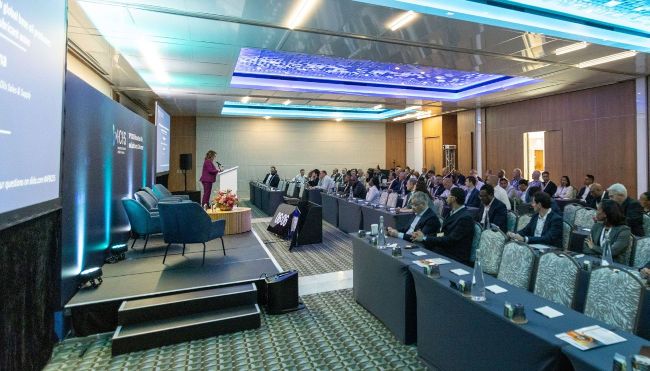
Day 1 of the ICIS conference in South Africa.
SOURCE | ICIS
Africa is still in the early stages of this transition, but the shift is underway. What emerged from the conference is that there will be increased volumes of Group II base oil exported to Africa from the Middle East and Asia in 2026.
In addition to Group II base oil influencing formulation changes across the continent, attention to improving air quality and the need to reduce emissions are also affecting formulations. Legislative changes that limit the year of manufacture for vehicles imported into Africa has led to newer vehicle models that require higher-quality lubricants being imported, thereby necessitating a change in formulation.
With these drivers for formulation change, emphasis was placed on formulating lubricants tailored to the African continent’s unique needs. To adequately tackle this, empowering local production, which is currently underutilized, is vital. To do this, it will require reliable supply chains, access to advanced technologies, investment in industry-wide knowledge sharing, and, after developing products for African conditions, ensuring they are also tested under the same conditions.
Looking at the challenges plaguing the African continent, counterfeits sit at the top. According to the Southern African Institute of Tribology (SAIT), 50%of lubricants tested in the market do not meet their declared specifications. Some of the drivers of counterfeiting on the continent are a need for low prices, a lack of enforcement of quality lubricants, corruption, and complexity in monitoring the supply chain. While in different countries there are bodies fighting counterfeits, more needs to be done in terms of regulatory enforcement, the use of QR codes for product verification, and educating consumers on the need for quality lubricants.
In closing the conference, the participants highlighted a few areas of improvement in the industry, including the need to share knowledge, as the knowledge gap is widening and is also missing from the school curriculum for engineering courses. While this is a global problem, one of the speakers highlighted that, “since this is a global problem, that does not mean Africa should be comfortable, but it should work on getting local solutions.”
The clarion call is to beef up industry regulations across the continent, and for all stakeholders in the entire supply chain to play a role and ask themselves what they will do to make the industry great with regard to quality lubricants, regulatory adherence, and knowledge transfer, among others..