
Technical Manager for WearCheck, Steven Lumley, explains the benefits and functions of PPDs in this article.
During the ongoing journey through the world of additives with condition monitoring specialist company, WearCheck, one of the featured set of additives is those that affect the rheological behaviour of oils – Pour Point Depressants (PPDs).
Technical Manager for WearCheck, Steven Lumley, explains: ‘PPDs prevent congelation of the oil at low temperatures due to wax crystallisation by modifying the interface between the crystalised wax and the oil. Examples of PPDs include polymethacrylates (PMAs), alkylated wax naphthalene, and alkylated wax phenol.
‘Medically, “depressant” is synonymous with prescription drugs that sooth frayed nerves by lowering neurotransmission. However, in chemistry, a depressant is any agent capable of diminishing a specific property of a substance. A pour point depressant is therefore an additive that depresses the pour point of a lubricant.
‘An oil’s pour point is the lowest temperature at which it remains fluid. Wax crystals that form in paraffinic mineral oils crystallise (solidify) at low temperatures. These solid crystals form a lattice network that inhibits the remaining liquid oil from flowing.
‘In below-freezing temperatures, all paraffinic oils form wax crystals, which can hamper the oil’s fluidity (ability to flow). PPDs don’t stop crystal formation, but prevent wax crystals from agglomerating by reducing both the size of the crystals in the oil and their interaction with each other, allowing the oil’s continued fluidity at low temperatures.
‘PPDs are polymeric molecules that are added to mineral-oil-based lubricants that are exposed to low temperatures. They prevent a viscosity increase, so the oil will not flow too much and starve the system of the needed lubricant, especially during start-up.
In fact, the viscosity can increase such that the oil gels/ becomes semi-solid. The critical applications include engine, transmission, gear and hydraulic lubricants.
Many of these lubricants have predominantly paraffinic base stocks, which contain significant wax concentrations, resulting in pumpability issues at low temperatures. Additionally, waxy components are added to a formulation as elements of the detergent, or in some viscosity index improver packages.
These waxy molecules, at low temperature (below the cloud point: temperature at which an oil’s dissolved solids (e.g., paraffin wax) begin to form and separate from the oil), cause a rapid increase in the oil’s viscosity, and the waxy molecules begin to crystallise. The oil clouds, and ultimately these wax crystals can precipitate from the lubricant. PPDs slowly increase the oil’s velocity with decreasing temperature, as it does above the cloud point, but prevent the rapid increase in viscosity associated with waxy crystal formation.
PPDs are polymeric molecules that are added to mineral-oil-based lubricants that are exposed to low temperatures. .
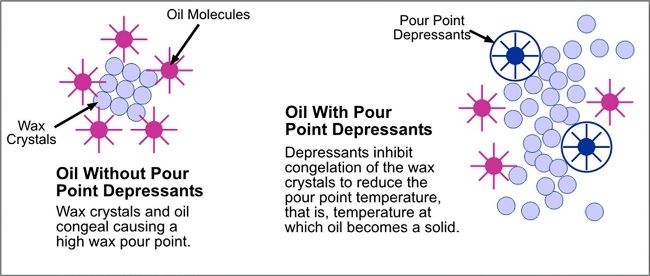
A pour point depressant (PPD) is an additive that depresses the pour point of a lubricant, enabling it to flow even when the temperature is low.
SOURCE | WEARCHECK
‘PPDs are polymeric materials made from many different polymer chemistries such as acrylates, styrenes, alpha olefins, vinyl acetates, and others. These chemistries, when polymerised, form a linear backbone that can have side chains with varying long (waxy) and short (nonwaxy) hydrocarbons. Imagine the polymers similar to a hair comb, but with long and short teeth. This structure inhibits the formation of wax crystals by virtue of the long-chain portions of the PPD partially co-crystallising with the wax and the short chains aiding in solubilising the lubricant’s complex.
‘A dominant chemistry used for PPDs is the polymethylmethacrylates (PMAs), which have an inherent oxidative and thermal stability, making them ideal for engine oils. This meets the requirements of automotive OEMs for low-temperature pumpability of used engine oils. In addition to concern about wax-crystal formation, there are the effects of oxidation on the oil-forming polar molecular species that can also form gels and raise the used oil’s viscosity. Thus, PPDs are hardly depressing but are one more tool formulator that enhances lubricants’ performance in engines, transmissions, gears, and hydraulics.’
Visit www.wearcheck.co.za or email marketing@wearcheck.co.za for more information.