ROCOL, a manufacturer of industrial lubricants, has announced it has received the National Sanitation Foundation’s (NSF) new Per- and Polyfluoroalkyl Substances (PFAS) free certification for four products in its FOODLUBE range. NSF approved ROCOL’s food-grade lubricant products with its Sustainability Assessment for Water Treatment Chemical Products ANSI/NSF 537 certification, which provides criteria for assessing the environmental and human health impacts of water treatment chemical products, including lubricants or additives used in water-intensive operations following extensive testing. The accreditation, which can only be issued by the NSF, was launched earlier this year (March 2025) and is the first of its kind, marking a significant milestone in food safety and environmental responsibility.
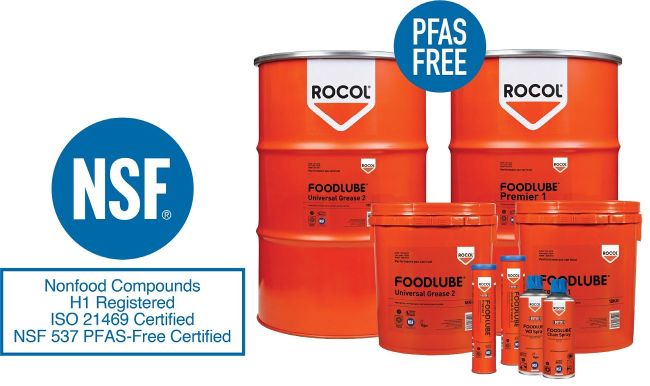
SOURCE | ROCOL
According to ROCOL, the company initially tested the most widely used lubricants in the FOODLUBE range:
• FOODLUBE Premier 1
• FOODLUBE Universal 2
• FOODLUBE WD Spray
• FOODLUBE Chain Spray products ROCOL is currently working with the NSF to test a further 25 FOODLUBE products in its range for the NSF 537 certification.
Jess Baker, Senior Scientist at ROCOL, who also worked with the NSF on the testing for the new certification, said: “The NSF’s new PFAS accreditation is a significant step forward for the food industry, and we’re proud to have helped bring it to life. Being the first to receive this certification reflects our commitment to both our customers and the planet, setting a new industry benchmark. This milestone reinforces the quality, durability, and safety of our FOODLUBE products while upholding the highest environmental standards. We’re looking forward to completing the accreditation across the full range.”
“With mounting concerns and new regulations being introduced regarding PFAS in our environment and food supply, NSF 537 represents a significant leap forward in consumer safety and transparency,” said Sam Cole, Director of Food Contact Evaluation at NSF. “ROCOL’s achievement as the first manufacturer to meet these rigorous standards demonstrates its commitment to food safety and environmental responsibility. Their proactive approach helps set a new benchmark for the industry.”
“This certification is not just about meeting current standards; it’s about anticipating future needs in food safety,” added Cole. “As the first of its kind, NSF 537 provides food manufacturers with clarity and confidence when selecting materials that come into contact with food production environments.”