In asset-intensive industries, lubrication is often treated as a routine maintenance activity - necessary, repetitive and largely procedural. However, this perspective significantly understates its importance. Lubrication is a critical control mechanism that influences equipment health, failure rates, lifecycle costs, operational risk and overall business performance. In some contexts, it can even be viewed and managed as an asset.
Across oil and gas, mining, refining, aviation, power generation and manufacturing, lubrication-related factors are associated with a substantial proportion of equipment failures, often exceeding 50%. Despite this, lubrication programmes frequently remain disconnected from broader reliability engineering and asset management strategies. Organisations may invest heavily in predictive maintenance technologies and reliability initiatives while overlooking one of the most cost-effective opportunities for improving equipment performance: lubrication excellence.
The challenge, therefore, is to transform lubrication from a routine maintenance function into a strategic reliability discipline.
The Hidden Cost of Poor Lubrication
Many facilities operate with lubrication practices that inadvertently introduce risk. Oil changes may be performed according to calendar schedules rather than lubricant condition, grease may be applied according to habit rather than calculated requirements, and lubricants may be stored in conditions that encourage contamination. When lubrication-related failures occur, they are also frequently treated as isolated incidents rather than symptoms of wider systemic problems.
The consequences can include premature bearing and gearbox failures, increased friction and energy consumption, elevated operating temperatures, reduced equipment life, lower Mean Time Between Failures (MTBF), higher maintenance costs and increased unplanned downtime.
From an asset management perspective, these represent uncontrolled degradation mechanisms that progressively erode equipment performance and business value. If lubrication is not actively managed, equipment reliability is inevitably compromised.
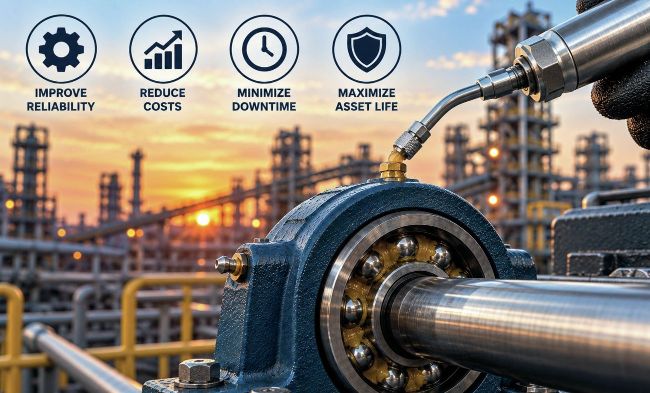
Precision lubrication ensures maximum uptime and industrial reliability.
SOURCE | MAGNIFIC
Lubrication as an Engineered Reliability System
Equipment failures rarely occur without warning. Assets generally deteriorate through identifiable failure mechanisms, many of which are directly influenced by lubrication. Wear, corrosion, contamination, overheating and fatigue can either be accelerated or mitigated depending on how effectively lubrication is managed.
For this reason, lubrication should be treated as an engineered system governed by standards, controls, monitoring and continuous improvement. Six key pillars provide a practical framework for achieving this.
1. Correct Lubricant Selection
The starting point is selecting the correct lubricant for the application. Selection must account for load, speed, temperature, environmental conditions and equipment design. Viscosity, base oil composition and additive chemistry all influence lubricant performance.
An unsuitable lubricant can contribute to excessive wear, overheating, micro-pitting, increased energy losses and premature component failure. Conversely, correct selection can improve film strength, reduce friction and extend component life.
Where practical, organisations should also consider lubricant consolidation. Reducing the number of lubricants used across a facility can minimise complexity, lower cross-contamination risks and simplify inventory management.
2. Lubricant Health Management
Lubricants degrade over time through oxidation, thermal stress, contamination, additive depletion and moisture ingress. Traditional time-based oil changes can therefore result in lubricants being replaced prematurely or remaining in service beyond their effective condition.
Condition-based lubricant management, supported by oil analysis, provides a more effective approach. Routine analysis can identify viscosity changes, oxidation, acid formation, water and particle contamination, as well as additive depletion.
Importantly, oil analysis provides information about both lubricant health and equipment condition. By establishing alarm limits and trending lubricant condition over time, organisations can make data-driven maintenance decisions, optimise lubricant service life and reduce the risk of equipment failure.
3. Contamination Control
Contamination is one of the major threats to machine reliability. Particles and moisture can significantly accelerate wear in bearings, gears and hydraulic systems.
Contamination control must begin before the lubricant reaches the machine. Effective practices include proper storage and handling, sealed transfer containers, dedicated dispensing equipment, desiccant breathers, high-efficiency filtration and routine cleanliness monitoring.
Leading organisations establish target cleanliness levels according to equipment criticality and verify compliance through regular testing. Controlling contamination can extend both lubricant and equipment life while reducing failure rates.
4. Precision Lubricant Application
More lubricant does not necessarily mean better lubrication. Over-lubrication is a significant contributor to bearing failures, as excess grease can cause churning, increased temperatures, seal damage and lubricant degradation. Under-lubrication, meanwhile, can leave components exposed to metal-to-metal contact and accelerated wear.
Lubrication sits at the intersection of maintenance, reliability and asset management. When treated merely as a maintenance task, it remains an operational necessity with limited perceived strategic value. When managed as an engineered reliability system, however, it becomes a powerful driver of equipment performance, lifecycle optimisation and business success.
Precision lubrication requires lubricant quantities to be calculated according to equipment design, optimised re-lubrication intervals to be established, and tools such as ultrasound-assisted lubrication to be used where appropriate. Operating temperatures and equipment condition should also be monitored, while standardised lubrication procedures should guide execution.
This approach moves lubrication away from experience-based routines and towards a controlled, data-driven engineering process.
5. Root Cause and Failure Management
Reactive maintenance often follows a familiar cycle: equipment fails, components are replaced and production resumes, while the underlying cause remains unresolved.
Reliability-centred organisations take a different approach by investigating lubrication-related failures systematically and incorporating the findings into broader reliability improvement programmes.
Tools such as Failure Reporting, Analysis and Corrective Action Systems (FRACAS), Reliability Growth Analysis, Defect Elimination Programmes, Failure Mode Analysis and condition-monitoring correlation can help identify recurring failure patterns and eliminate their underlying causes.
The shift from simply responding to failures to eliminating defects is where lubrication begins to deliver significant reliability value.
6. Safety, Sustainability and Environmental Stewardship
Modern lubrication programmes must also address environmental and workplace risks. Poor practices can contribute to oil spills, environmental incidents, excessive waste, manual handling risks and regulatory non-compliance.
Leading organisations are responding through closed-loop lubrication systems, spill prevention and containment programmes, lubricant recycling and reconditioning, consumption reduction and waste-oil minimisation initiatives.
These measures can simultaneously improve environmental performance, reduce operating costs and support broader corporate sustainability objectives.
Integrating Lubrication into Asset Management
The greatest benefits emerge when lubrication is integrated into the wider asset management strategy rather than remaining the responsibility of maintenance alone. Operations, reliability, engineering, procurement and leadership teams must work together to establish a consistent approach.
Five enablers are particularly important: governance and standards, data-driven decision-making, competency development, technology and infrastructure, and cultural transformation.
Organisations need clear lubrication policies, procedures and performance expectations. Lubricant analysis and condition-monitoring data should inform maintenance decisions and resource allocation. Personnel must have the technical knowledge required for precision lubrication, while appropriate storage systems, filtration technologies, monitoring tools and digital management systems provide the necessary infrastructure.
Equally important is cultural change. Lubrication must be recognised across the organisation as a strategic contributor to reliability rather than simply another maintenance task.
The Business Impact
Reliability-centred lubrication programmes can produce measurable operational benefits. These may include lubricant consumption reductions of 20–40%, reductions in hydraulic and bearing failures of up to 50%, longer lubricant service life, improved equipment availability, increased MTBF, lower maintenance costs and reduced total cost of ownership.
Beyond these measurable outcomes, effective lubrication management can produce a broader cultural shift - from reactive maintenance towards proactive asset management. Reliability becomes more predictable, maintenance more efficient and operational risk more manageable.
Conclusion
Lubrication sits at the intersection of maintenance, reliability and asset management. When treated merely as a maintenance task, it remains an operational necessity with limited perceived strategic value. When managed as an engineered reliability system, however, it becomes a powerful driver of equipment performance, lifecycle optimisation and business success.
World-class reliability does not necessarily depend on the most sophisticated technologies or the largest maintenance budgets. More often, it comes from consistently executing fundamental practices with discipline, precision and effective control.
Lubrication management is one of those fundamentals.
For reliability professionals, maintenance leaders and asset managers, the opportunity is clear: elevate lubrication from a routine activity to a strategic discipline. The potential rewards - in reliability, cost reduction, sustainability and operational excellence - are too significant to ignore. .