COPIED
2 mins

BASE OILS

The Global Group III Base Oil Shortage: Strategic Implications for African Lubricant Buyers

Group III base oils have become a critical feedstock for modern lubricants, particularly synthetic and semi-synthetic engine oils, low-viscosity passenger car motor oils, automatic transmission fluids, and OEM-approved formulations. Their high viscosity index, low volatility, low sulfur content, and oxidation stability make them essential for products designed around fuel economy, longer drain intervals, and tighter emission-related performance standards.

The current Group III supply squeeze is not simply a pricing cycle. It is a structural stress test for lubricant supply chains. Middle East supply disruption, constrained exports, longer shipping routes, elevated freight costs, and strong global demand for premium lubricants have combined to tighten availability. The result is longer lead times, reduced spot availability, allocation pressure, and higher replacement costs for blenders.

For Africa, the risk is significant because most premium base oils are imported. Local blenders in markets such as South Africa, Nigeria, Kenya, Egypt, Morocco, Ghana, Tanzania, and Côte d’Ivoire depend heavily on overseas suppliers for Group II, Group III, additives, and finished lubricant technology packages. When global supply tightens, African buyers are usually exposed later than larger Western buyers but often feel the impact more severely because of smaller parcel sizes, limited storage, longer financing cycles, foreign-exchange constraints, and weaker negotiating power with major suppliers.

The impact will not be uniform across all lubricant categories. Basic monogrades, conventional diesel engine oils, industrial hydraulic oils, gear oils, and greases may face cost pressure but are not the most exposed. The highest risk sits in low-viscosity synthetic passenger car oils such as 0W-20 and 0W-16, OEM-approved 5W-30 and 5W-40 formulations, advanced ATF/CVT/DCT fluids, and products where reformulation is restricted by approvals or warranty requirements.

This matters commercially. African lubricant buyers may face fewer brand options, reduced promotional pricing, delayed shipments, and greater pressure to accept substitute formulations. Fleet operators, mining companies, transporters, workshops, and distributors should not treat this as a routine procurement issue. Lubricant continuity now directly affects operating uptime, warranty compliance, and total cost of ownership.

The correct response is not panic buying. It is disciplined procurement risk management. Buyers should classify products by Group III dependency, identify critical SKUs, extend procurement visibility from monthly buying to rolling 90–180 day planning, and avoid over-reliance on a single supply region. Blenders should secure alternative approved formulations, review additive-package flexibility, increase strategic tankage where financially viable, and negotiate allocation commitments with suppliers.

Re-refined base oils may become part of the long-term answer, but this must be treated realistically. Most re-refining systems produce Group I or Group II-type material, not direct Group III substitutes. They can improve sustainability and reduce dependence on virgin base oils in selected applications, but they cannot automatically replace high-performance Group III in OEM-approved synthetic engine oils.
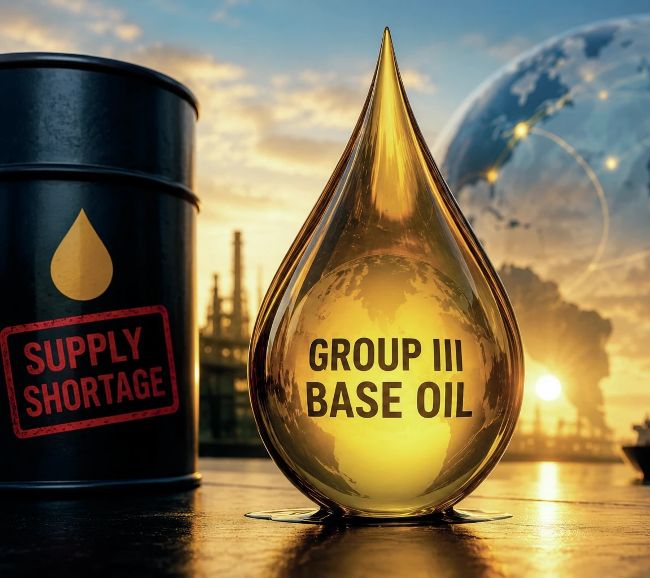
SOURCE | MAGNIFIC

The deeper lesson for Africa is clear: lubricant competitiveness is no longer only about price, brand, or distribution. It is about supply-chain resilience, technical formulation capability, inventory discipline, and access to reliable global feedstock channels.

The Group III shortage is therefore more than a temporary market disruption. It is a warning that African lubricant companies must move from transactional buying to strategic procurement. Those that secure diversified supply, build stronger technical partnerships, and manage inventory scientifically will be better positioned than those waiting for the market to normalize. .

This article appears in Issue 58

Go to Page View
This article appears in...
Issue 58
Go to Page View
The Litre is Only the Beginning
W elcome to the 58th edition of Lubezine
ADNOC Distribution enters into Definitive Agreement to Acquire Shell Downstream South Africa
PAN-AFRICAN BRIEFING
BRANDS IN BRIEF
OLA Energy Expands Ethiopia Presence Through Acquisition of
Engen DRC: Launch of Shell Lubricants in the DRC
PAN-AFRICAN BRIEFING E ngen DRC, a subsidiary of
Lubrizol Expands Fluid Engineering Distribution Network Across Africa
L ubrizol is expanding its Fluid Engineering (LFE)
Nasan Energies Acquires 52 Fuel Stations in US$50 Million Deal
N amibian-owned Nasan Energies has completed the acquisition
Vivo Energy Tunisia Expands Shell Lubricants Distribution Through Equip Auto Partnership
V ivo Energy Tunisia has announced the signing
TotalEnergies Tunisie Partners with AD Tunisie and Ulysse Spare Parts
PAN-AFRICAN BRIEFING T otalEnergies Marketing Tunisie and AD
Kemipex Commences Lubimax® Additive Sales in Nigeria
K emipex Limited has commenced sales operations in
OLA Energy Acquires TotalEnergies’ Ethiopia Network, Ending 76-Year Presence
O LA Energy has signed an agreement to
Vivo Energy Extends Beyond Africa, Buys out Total Energies in Jordan
V ivo Energy has expanded beyond Africa for
It’s More Than Just Oil
A CONVERSATION WITH STEVEN LUMLEY
Re-Refined Base Oils: Understanding RRBO Quality, Performance and Value
This edition’s FAQ section examines re-refined base oils (RRBO), from how used lubricants are transformed into base oils to quality, performance, feedstock suitability, and cost. It provides practical insights into RRBO production, application, and its growing role in circularity and sustainable lubricant manufacturing.
THE LUBES DIARY
EVENTS FROM ACROSS THE GLOBE
Lubricants: Consumables or Repairable Spare Parts?
I n most maintenance organizations, lubricants are classified
Launches PC-12 Additive
PRODUCTS & INNOVATIONS
FUCHS UK Announces Investment in New Quality Control Laboratory
F UCHS Lubricants (UK) plc has announced an
Introduces Restore & Protect Lubricant in Europe
V alvoline Global Operations, a manufacturer of automotive
A landmark MoU signed between OilOnWheelz and Hindustan Petroleum Corporation Limited
E very meaningful change begins with one simple
Aramco and FUCHS Sign Global Base Oils Agreement to Strengthen Long-Term Collaboration
A ramco and FUCHS have signed a Global
BP Sells Majority Stake in Castrol in US$10.1 Billion Deal
B P has sold majority control of Castrol
The Evolution of Circularity: Pioneering Re-Refining in Egypt’s Lubricant Sector
N early a decade ago, in 2017, we
Motul Develops Bespoke Gearbox Lubricant for McLaren F1
M cLaren Racing and Motul have expanded their
PETRONAS Lubricants India Partners with Maruti Suzuki India
P ETRONAS Lubricants India is the appointed supplier
Shell and Hyundai Motor Renew Their Partnership
S hell Lubricants and Hyundai Motor Company have
PSP Energy secures Sinopec lubricants distribution rights
P ETALING JAYA: PSP Energy Bhd , via
Tata Motors and Castrol India Collaborate to Advance Used Oil Circularity
Castrol and Tata Motors executives proudly display signed
SK Enmove, HF Sinclair Announce Group III Agreements
S K Enmove has entered into strategic agreements
Vitol Sells Its VTX Energy Company To Verde Operating Company
V itol has agreed to sell its US
Valvoline Launches Valco Company in Saudi Arabia
V alvoline Global Operations, an automotive and industrial
A Hidden Sustainability Challenge
From Waste to Worth Sustainability Used Oil and
Building Competitive Lubricant Businesses in Africa
In this edition, Lubezine features Irfan Khan, Founder and Director of Business Development at GAUGE ENERGY, whose experience in finance, lubricants, blending, and market development offers practical perspectives on Africa’s evolving lubricants industry and future.
The Global Group III Base Oil Shortage: Strategic Implications for African Lubricant Buyers
G roup III base oils have become a
From Maintenance Task to Reliability Driver in Modern Asset-Intensive Industries
I n asset-intensive industries, lubrication is often treated
Looking for back issues?
Browse the Archive >

Previous Article Next Article
Issue 58
CONTENTS
Page 29
PAGE VIEW