Nearly a decade ago, in 2017, we shared our early experiences with Lubezine readers as we navigated the infancy of Egypt’s base oil re-refining industry. Today, as we reflect on the journey of Relubes for Environmental Solutions, the conversation has shifted from mere waste disposal to the critical concepts of sustainability and circularity.
Relubes for Environmental Solutions was commissioned on schedule in 2020 as a strategic upgrade to our original facility, Hi Tech Oils & Grease, which was established in 2008 and commissioned in 2012. Backed by investors with decades of experience re-refining base oils across the Middle East, we built upon a foundation of experienced fabricators, operators, engineers, and management. Yet, despite our expertise, the journey from planning to production required four grueling years. The primary struggle was not technical, but bureaucratic.
Establishing a truly circular industry in a new market requires paving unmapped regulatory roads. For pioneers, the “one-stop-shop” for licensing is a myth. It required having dedicated personnel in government agencies daily to file documents, follow up on applications, and educate regulators.
It is important to emphasize that we did not invent a new technology; rather, we introduced the proven, sustainable process of re-refining into a new and emerging market: Egypt.
The Evolution of Feedstock: From Waste to Commodity
As a pioneer in the Egyptian market, our team has had a front-row seat to the evolution of used lubricants. We have watched this resource transform from a hazardous waste liability into a highly sought-after feedstock.
In the beginning, the local infrastructure was not accommodating. Safe disposal was inconvenient, complicated, and largely absent from the day-to-day operations of small-to-medium enterprises (SMEs). While authorized dealerships had Standard Operating Procedures for handling and disposal, these practices came with significant additional costs. When we began collecting used lubricants in 2012, the acquisition price was negligible. Sellers were simply relieved to dispose of their waste without incurring transportation and environmental penalties.
Relubes for Environmental Solutions was commissioned on schedule in 2020 as a strategic upgrade to our original facility, Hi Tech
Oils & Grease, which was established in 2008 and commissioned in 2012.
This era marked the true beginning of value creation for a sustainable, circular industry in Egypt. At a time when used lubricants cost approximately $100/MT to acquire and virgin base oil prices hovered around $1,000/MT, the economics confirmed that the Egyptian re-refining sector had massive incentives to grow. However, we knew that a maturing market would eventually compress these margins.
Navigating the Fuel Peg and Volatility
Not long after our operations began, Egypt faced severe economic headwinds, including deficits and foreign currency shortages. In response to these acute fuel shortages, struggling local industries found an easy, albeit environmentally damaging, alternative: burning used lubricants alongside other grades of fuel to power the production.
This practice abruptly altered the market dynamics. Used lubricant prices became dynamically pegged to local diesel and furnace fuel prices, which were themselves influenced by swinging global crude prices and local economic subsidies. Suddenly, we were competing against the energy sector for our raw materials. This created our first significant obstacle, temporarily eroding our price advantage over virgin base oils.
We emerged from this period with a crucial realization: if our feedstock costs were permanently anchored to other petroleum products,we could no longer rely on price as our sole advantage. Virgin oil prices serve as a ceiling only when a re-refiner lacks other value propositions.
The broader African market often tolerates lower grades of lubricants, largely due to an aging fleet of vehicles and industrial equipment. While we respect customers’ choices and refuse to compete with non-compliant, counterfeit products, we do have to compete with these bad actors for used lubricant feedstock.
Consequently, we pivoted hard toward quality. We modified our re-refining processes to dramatically improve consistency, producing a product of near Group II quality. This allowed our customers to seamlessly substitute certain virgin base oils with our circular products. Our laboratory became the beating heart of this evolution, serving as the foundation for a value proposition built on performance and sustainability rather than just economics.
Strategic Expansion and Pandemic Resilience
By 2017, we had maximized the utilization of Hi Tech Oils & Grease’s 5,000-square-meter footprint. Furthermore, our legacy facility was geographically isolated on the Sinai Peninsula. Driven by the relative political and economic stability returning to Egypt after the turbulence of 2011–2018, we made the strategic decision to establish a larger, improved facility in a true petroleum hub.
We evaluated Alexandria and Suez, ultimately choosing Suez for its central location, which facilitated vastly greater logistical reach for collecting feedstock.
However, in the global commodities market, volatility never abates for long. It returned ferociously in 2020 as crude futures turned negative at the onset of the COVID-19 pandemic—a crisis that coincided exactly with the commissioning of our new Relubes facility. Competing with virgin oil suddenly offered at $600/MT was virtually impossible.
During this time, our focus shifted entirely to business continuity. We succeeded by leaning on our long-term business relationships. We were also fortunate that Egypt did not implement the total economic lockdowns seen in other nations. This pragmatic approach allowed our feedstock to remain available and ensured that, while demand was reduced, it was never fully extinguished.
The Challenges of a Maturing Circular Economy
As the pandemic subsided in 2023, a wave of new re-refiners entered the Egyptian market. This led to fierce competition for used lubricant feedstocks, signaling the coming of age for the sustainability and circularity of our sector. It took just over ten years for this industry to develop from infancy into a mature, highly competitive segment of the regional base oil market.
However, maturity brings new threats. Bad actors began appearing within the sector, producing non-compliant, poorly re-refined base oils primarily used for counterfeiting international brands like Mobil and Shell. These unlicensed operators take advantage of hyper-inflation, supply chain disruptions, and the lucrative black market for lubricants.
The broader African market often tolerates lower grades of lubricants, largely due to an aging fleet of vehicles and industrial equipment.
While we respect customers’ choices and refuse to compete with non-compliant, counterfeit products, we do have to compete with these bad actors for used lubricant feedstock.
This dynamic strikes at the very heart of the circular economy. When low-grade lubricants are produced and used, their change intervals are drastically reduced. This increases the frequency of oil changes, the energy required for constant re-refining, and the molecular loss during the process. True circularity is about efficiency; when the same degraded lubricant is repeatedly used and inefficiently re-refined, waste is compounded, and the environmental benefits of our industry are severely diminished.
The Final Frontier: Unlocking Regional Trade
The ultimate solution to these bottlenecks lies in regulatory reform. Allowing the transparent, regulated export and import of waste lubricants is the final frontier for facilitating true circularity in the regional lubricant industry.
Opening cross-border trade for used oil would decouple feedstock prices from local fuel pegs and alleviate the artificial scarcity driving fierce local competition. By allowing legitimate, high-efficiency re-refiners to source feedstock regionally, the market would naturally squeeze out unlicensed operators producing lower-grade base oils. Ultimately, this policy shift would elevate the baseline quality of the entire African lubricant industry, ensuring that circularity delivers on its promise of both economic value and environmental protection. .
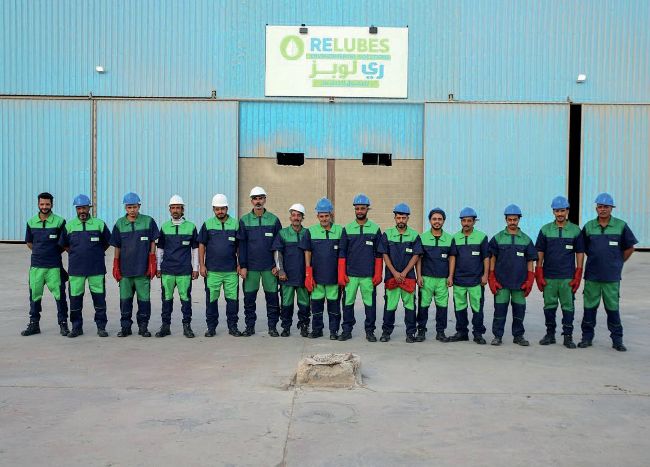
Relubes Team at Its Re-Refining Facility.
SOURCE | RELUBES